
Which Martial Art is the Hardest to Learn? 16 Disciplines Ranked by Difficulty
Updated on September 16th, 2026 at 02:03 pm
** Reviewed by Supreme GrandMaster S.H. Yu, Kukkiwon International Advisory Board
Brazilian Jiu-Jitsu is the hardest major martial art to learn, averaging 8 to 10 years to black belt. Most traditional arts take 3 to 6 years: Tae Kwon Do 3 to 5, Karate 4 to 5, Hapkido about 5, Judo and Aikido 4 to 6.
Difficulty is not the same as intensity. The martial arts that take the longest to learn are the ones that demand precision under live resistance, not the ones with the hardest conditioning.
Supreme GrandMaster S.H. Yu has spent nearly 60 years studying and teaching traditional martial arts. His answer: the hardest martial art is the one that challenges your weaknesses. Skill becomes mastery only through perseverance, accuracy, and discipline.
Key Takeaways
- Brazilian Jiu-Jitsu is the hardest to learn because every technique is pressure-tested against a fully resisting opponent from the first month.
- Striking and grappling are hard differently. Grappling arts have longer timelines; striking arts have higher physical and psychological entry costs.
- The 12-year BJJ figure and the 8-to-10-year figure both circulate. They measure different things, and the difference is explained below.
- Traditional arts are graded, not easy. Structured curricula make them accessible early and demanding at advanced rank.
- Your instructor changes your timeline more than your style does. Correction in week two saves a year of unlearning.
What Makes a Martial Art Hard to Learn?
A martial art is hard to learn when it demands exact technique under pressure, not when it demands the hardest workout. Five factors determine where a style falls.
Physical Demand
Strength, flexibility, endurance, and reaction speed. Arts built on ground work or high kicking place the steepest physical demands on new students.
Technical Volume
The number of techniques and the precision each one requires. A curriculum with 300 techniques takes longer than one with 80, even when the individual movements are simpler.
Mental Discipline
Focus, patience, emotional control, and the ability to stay relaxed under pressure. This is the factor beginners underestimate most often.
Live Resistance
Styles with full sparring, randori, or rolling take longer to become effective in, because every technique has to work against someone actively trying to stop it.
Time to Proficiency
Some belt systems are deliberately slow. A long timeline usually reflects a standard the school refuses to lower rather than a technique that is harder to perform.
Which Martial Arts Are Hardest to Learn? A Difficulty Comparison
Ten major martial arts ranked by typical time to black belt and overall learning difficulty for a consistently training student.
| Martial Art | Primary Focus | Time & Difficulty |
|---|---|---|
| Brazilian Jiu-Jitsu | Grappling, ground fighting, submissions | 8–10 years Very hard |
| MMA | Striking, wrestling, ground | 8–10 years Very hard |
| Classical Kung Fu | Forms, conditioning, internal power | 10+ years Very hard |
| Wrestling | Takedowns, pins, escapes | 4–6 years Hard |
| Muay Thai | Eight striking surfaces, clinch | 3–5 years Hard |
| Combat Sambo | Throws, leg locks, striking | 5–7 years Hard |
| Boxing | Footwork, head movement, timing | 2–4 years Hard |
| Judo | Throws, pins, randori | 4–6 years Hard |
| Krav Maga | Real-world self defense | 5–7 years Hard |
| Hapkido | Locks, throws, kicks, weapons | About 5 years Hard |
| Aikido | Joint locks, redirection | 4–6 years Hard |
| Tai Chi | Internal power, breath, structure | 5+ years Moderate to hard |
| Kickboxing | Punches and kicks, no clinch | 4–5 years Moderate to hard |
| Karate | Striking, stance, power generation | 4–5 years Moderate |
| Kumdo and Gumdo | Sword technique, precision | 4–5 years Moderate |
| Tae Kwon Do | Kicking, speed, forms | 3–5 years Moderate |
* Figures are typical ranges for students training consistently. Disciplines without a belt system are measured to competitive readiness instead.
Read: What is the Easiest Martial Art to Get A Black Belt In?
Hardest Grappling Martial Arts to Learn
Brazilian Jiu-Jitsu
Brazilian Jiu-Jitsu is the hardest major martial art to learn because every technique must work against a fully resisting opponent from the first month. The syllabus covers hundreds of positions, sweeps, submissions, and escapes, none of which can be memorized into competence.
There is no way to muscle through it. A submission that is a few degrees off does not partially work; it fails. Blue belt alone commonly takes 1 to 2 years.
Wrestling
Wrestling is the most physically punishing martial art to learn, with no belt system and roughly 4 to 6 years to competitive proficiency. The technical range is narrower than BJJ, built on takedowns, pins, and escapes.
The difficulty sits in execution. Every technique demands explosive speed and exact timing against an opponent doing the same thing back, and conditioning sessions are designed to find the limit rather than approach it.
Judo
Judo takes 4 to 6 years to black belt and is difficult in a way that arrives early. Throws depend on grip, timing, and the split second an opponent’s balance breaks, which only develops through live randori.
Falling is its own curriculum. Before a student throws anyone safely, they are thrown hundreds of times, and breakfall training is where most beginners meet the real difficulty.
Combat Sambo
Combat Sambo takes roughly 5 to 7 years to black belt and is hard because of its range. Students train takedowns, throws, leg locks, and striking, then transition between standing and ground work continuously.
Leg attacks appear early in the syllabus, which is unfamiliar ground for most beginners. The individual techniques are learnable quickly; applying them at speed against resistance is what takes years.
Hardest Striking Martial Arts to Learn
Muay Thai
Muay Thai is the hardest striking art to learn because it uses eight weapons rather than two. Practitioners develop fists, elbows, knees, and shins, then add the clinch, a form of standing grappling that connects directly to the striking game.
Most gyms use no belt system, and competitive proficiency generally takes 3 to 5 years. Shin conditioning is the element beginners are least prepared for.
Boxing
Boxing looks simple and has one of the highest skill ceilings in martial arts. Only the hands are used, but footwork, head movement, distance management, and punch selection take years to develop, with amateur competitive proficiency typically at 2 to 4 years.
The mental side is underrated. Staying composed and technically correct while being hit cleanly is a separate skill from throwing punches, and it is the one that takes longest.
Kickboxing
Kickboxing sits in the middle of the striking range, taking 4 to 5 years to black belt in belted systems. It adds kicks to the boxing toolkit without the elbows, knees, and clinch work found in Muay Thai.
For most adults the first obstacle is coordination. Throwing a punch feels natural, kicking at head height does not, so hip mobility and flexibility become limiting factors within the first months.
Karate
Karate takes 4 to 5 years to black belt and is moderately difficult to learn. Basic strikes and stances are accessible within the first months, which is why beginners feel fast early progress.
Proficiency takes considerably longer. Generating power through the hips, holding stance under fatigue, and executing kata with correct timing are what separate a competent student from a skilled one.
Tae Kwon Do
Tae Kwon Do is moderately difficult to learn, with most dedicated students reaching black belt in 3 to 5 years. Beginners progress quickly because the curriculum is clearly structured and the early forms are straightforward.
Difficulty climbs sharply at advanced rank. Jumping and spinning kicks demand flexibility, balance, and timing that take years to build, and senior forms are judged on precision most students do not have in their first two years.
Hardest Traditional Martial Arts to Learn
Classical Kung Fu
Classical Kung Fu systems are among the longest martial arts to learn, with traditional lineages expecting 10 years or more. Forms are long, conditioning is style-specific, and many systems layer internal training on top of the external curriculum.
Difficulty varies enormously by style. A modern wushu program and a traditional family system share a name and very little else in terms of learning curve.
Hapkido
Hapkido is one of the broadest martial arts to learn, taking roughly 5 years to black belt because the curriculum spans four skill sets instead of one. Students train joint locks, throws, kicking, and weapon technique, then move between them fluidly under pressure.
That breadth is why Hapkido ranks harder than most striking arts. A student can be strong in locks and still fail a promotion on throwing technique.
Aikido
Aikido looks gentle and is deceptively hard to learn, typically taking 4 to 6 years to black belt. The art is built on blending with an attacker’s momentum rather than opposing it, which requires timing and sensitivity that cannot be forced.
Beginners struggle because effort works against them. Progress comes from relaxation and correct positioning, and most students spend a first year unlearning the instinct to muscle through.
Kumdo and Gumdo
Kumdo and Gumdo take about 4 to 5 years to black belt and are difficult in a way that surprises new students. Sword work rewards exact posture, distance, and edge alignment, so small errors are immediately visible in a way they are not in empty-hand striking.
The art also demands sustained focus. A cutting sequence has to be performed with full commitment and full control at the same time.
Tai Chi
Tai Chi is regularly mistaken for light exercise and takes 5 years or more to reach genuine martial proficiency. As an internal art it depends on precise structure, breath control, and weight transfer that are invisible to an observer.
The slowness is the difficulty. Moving at speed hides errors; moving slowly exposes every one of them, which is why progress depends heavily on an instructor who can see them.
Hardest Hybrid Systems to Learn
MMA
MMA is the most technically expansive system to learn, with no unified belt system and generally 8 to 10 years to well-rounded competence. Students need functional skills in striking, wrestling, clinch work, and ground grappling, plus the transitions between all of them.
Being excellent in one range is not enough. Transitions are where most competitors are exposed, and training them means multiple sessions across different disciplines every week.
Krav Maga
Krav Maga uses relatively simple techniques and is hard for psychological reasons. Training deliberately places students under aggressive, unpredictable pressure, so the difficulty is reacting correctly while stressed rather than performing the movements.
Belt timelines vary by federation, running roughly 5 to 7 years in graded systems.
Why the Brazilian Jiu-Jitsu Black Belt Timeline is Disputed
Two figures circulate for how long a BJJ black belt takes, and they measure different things. The IBJJF minimum-time standards produce a typical path of 8 to 10 years for a consistently training adult. Other sources cite 12 years or more.
The shorter figure describes a student training several times a week without extended breaks. The longer figure reflects real-world averages, which absorb injuries, career interruptions, gym changes, and years spent training once a week rather than four times. Both are accurate within their own frame, and neither is wrong. The frequently repeated claim that under one percent of white belts ever reach black belt is widely circulated but not tied to any published dataset. Treat it as an illustration of attrition rather than a measured statistic.
The practical takeaway: the timeline you should plan around is the one that matches your training frequency, not the one that makes the best headline.
How Long Does It Take to Earn a Black Belt at Master S.H. Yu Martial Arts?
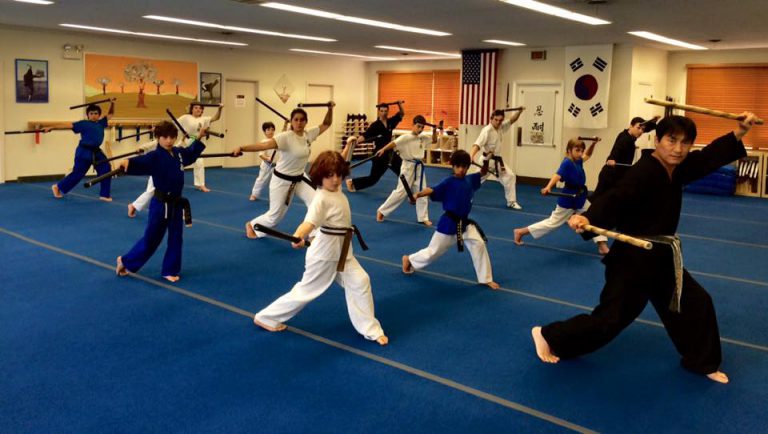
Students at Master S.H. Yu Martial Arts earn a black belt in an average of 4 years of consistent training. Every promotion is a formal test against a published curriculum, so rank reflects demonstrated skill rather than time enrolled.
Black belt candidates also complete a written essay. Students respond to essay questions throughout their training, and the promotion essay is reviewed alongside the physical test. The requirement exists because the school treats reflection and discipline as part of the rank rather than an addition to it. Supreme GrandMaster S.H. Yu has taught for nearly 60 years and sits on the Kukkiwon International Advisory Board.
Why Your Instructor Matters More Than the Martial Art
Your instructor matters more than the style you choose because the quality of correction determines how fast you actually improve. A skilled teacher catches an error in week two, before it becomes a habit that takes a year to unlearn.
Two students can train the same art for the same number of years and finish at very different skill levels based entirely on who was watching them. That gap widens in the harder arts, where a small technical error makes the technique fail outright.
Train with a True GrandMaster in Oak Park, IL
Master S.H. Yu Martial Arts teaches Tae Kwon Do, Hapkido, Aikido, Judo, and Kumdo in Oak Park, IL, serving River Forest, Elmwood Park, Forest Park, and Riverside. Classes run for children, teens, and adults.
Come watch a class before you decide. You can see the curriculum in practice, meet the instructors, and ask about the progression in whichever discipline interests you. Contact us today to schedule your free class observation.
Frequently Asked Questions (FAQs)
Which martial art takes the longest to learn?
Brazilian Jiu-Jitsu takes the longest of the major martial arts, averaging 8 to 10 years to black belt. Classical Kung Fu systems can take a decade or more. Tae Kwon Do, Karate, Judo, and Aikido generally range from 3 to 6 years.
Which martial art is the easiest to learn?
Tae Kwon Do is among the most accessible martial arts for beginners, with a structured curriculum and black belt timelines of 3 to 5 years. Easier to start does not mean easier to master, since advanced kicking technique is some of the most athletically demanding work in any art.
Which martial art is hardest to start as an adult?
Brazilian Jiu-Jitsu and Judo are typically hardest to begin later in life because of the ground work, impact, and conditioning involved. Adults often do better starting in an art with graded intensity and a structured progression, then adding grappling once conditioning improves.
Is Tae Kwon Do hard to learn for beginners?
Tae Kwon Do is one of the more beginner-friendly martial arts. The early curriculum is clearly structured, basic kicks are learnable within the first few classes, and belt progression gives new students visible milestones. Difficulty rises at advanced rank, where jumping and spinning techniques require developed flexibility and balance.
What martial arts are best for building discipline and focus?
Traditional arts such as Tae Kwon Do, Hapkido, and Karate build discipline most directly, because they pair repetitive technical practice with formal etiquette and graded testing. Schools that require formal promotion tests reinforce it further, since students prepare for a specific standard on a specific date.
Does the hardest martial art make the best self-defense?
No. Difficulty and self-defense value are separate things. Krav Maga uses relatively simple techniques and is built specifically for real-world defense, while several of the hardest arts to master are oriented toward competition or internal development. The more useful question is which art you will train consistently for years.