What Are the Benefits of Combining Martial Arts Disciplines?
Quick answer: Combining martial arts disciplines prepares you to defend yourself at every range: strikes at a distance, joint locks up close, and throws when a confrontation reaches the ground. It also builds more balanced strength, teaches you to fall safely, and keeps you progressing when one skill plateaus. The biggest gains come from an integrated curriculum, where the arts are taught together as one system in every class, rather than through training at separate schools.
Most people start martial arts by choosing one discipline and hoping it is the right fit. A growing number of schools take a different approach, teaching several arts together in one curriculum. Tae Kwon Do, Hapkido, Aikido, and Judo are a common combination because together they cover striking, joint locks, throws, and safe falling.
At Master S.H. Yu Martial Arts in Oak Park, IL, we have taught this way for more than three decades and have seen firsthand how combining disciplines builds more well-rounded skills, improves adaptability, and helps students grow both on and off the mat. So, what are the benefits of learning more than one martial art?
What Does it Mean to Combine Martial Arts Disciplines?
Combining martial arts disciplines means training in more than one style so you can develop a broader range of skills and respond to different situations. Most traditional martial arts fall into four broad categories:
- Striking arts: Such as Tae Kwon Do and Karate, emphasize kicks, punches, and blocks.
- Throwing arts: Such as Judo, focus on balance, timing, and leverage to bring an opponent to the ground.
- Joint-lock arts: Including Hapkido and Aikido, use redirection, control, and joint manipulation to manage an attacker.
- Weapon-based arts: Such as Kumdo, develop skills with the sword and other training weapons.
Each discipline approaches movement and self-defense from a different perspective. Learning more than one lets students build on each art’s strengths rather than relying on a single set of techniques.
What Is the Difference Between Cross-Training and an Integrated Curriculum?
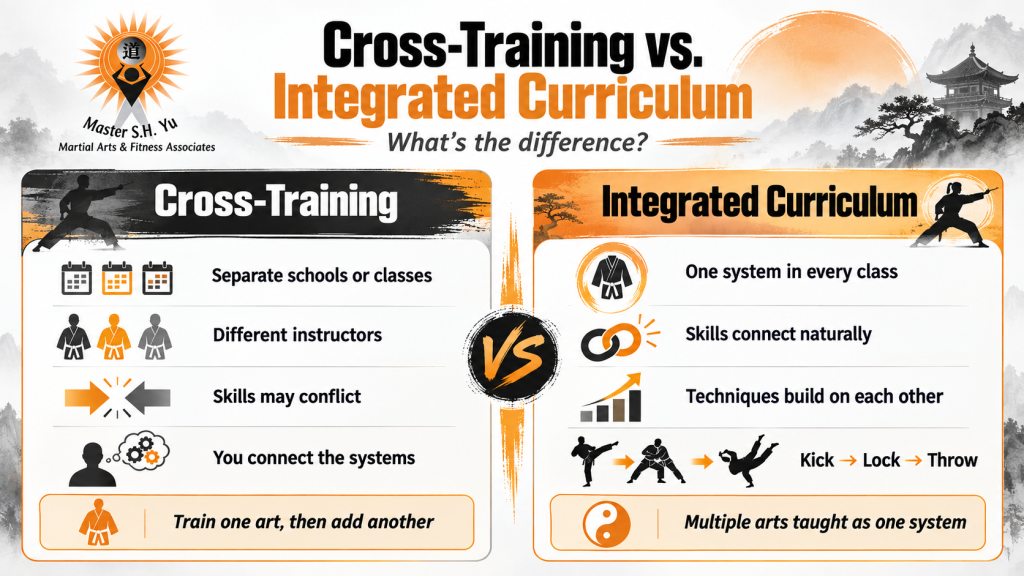
Cross-training adds a second martial art at a separate school, while an integrated curriculum teaches several arts together as one system in every class. The difference shapes how quickly skills connect. With cross-training, you usually train on a separate night with a different instructor who may never see you practice your primary art. You are left to figure out how the two systems fit together, even when they conflict. One instructor wants a wide stance; the other wants a narrow one.
An integrated curriculum takes the opposite approach. One system determines what comes first and how each skill connects to the next. A kick can set up a lock. A lock can flow into a throw. Techniques transfer naturally from one art to the next, without the scheduling conflicts of training at multiple schools.
7 Benefits of Learning Multiple Martial Arts
Combining martial arts disciplines gives students more than a longer list of techniques. When the arts are taught as one integrated curriculum, each skill reinforces the others. Here are seven key benefits.
1. You Can Defend Yourself at Every Range
Combined training prepares you for every stage of a confrontation, because real encounters rarely stay at one distance. A situation can start at kicking range, move into grabbing distance within seconds, and end on the ground.
Students who train in only one style may be highly skilled at one range but less prepared for the others. A kicker who gets grabbed needs a way to respond, and a grappler who cannot close the distance may absorb strikes on the way in. Combined training builds options for each stage: strikes to manage distance, joint locks for close-range control, and throws and ground transitions when the fight hits the mat.
2. You Build Balanced Strength Instead of Overusing One Movement Pattern
Training several arts spreads the workload across more muscles and joints, which helps prevent the overuse that comes from repeating one movement thousands of times. Years of kicking alone can place most of the stress on the same hips, knees, and ankles.
Each art contributes something different. Judo develops grip, core, and posterior-chain strength. Hapkido and Aikido challenge wrist mobility, balance, and rotational control. Tae Kwon Do builds leg flexibility and cardiovascular fitness. Together, they develop a more balanced, versatile body.
The American Academy of Pediatrics has cautioned against early single-sport specialization in young athletes, citing higher risk of overuse injury and burnout.
3. Falling Safely Becomes a Trained Skill
Judo and Aikido teach breakfalls, techniques for landing so impact spreads across the body instead of concentrating on a wrist, elbow, or the back of the head. Students practice them until the movement becomes automatic. This benefit is often overlooked, but it may be one of the most useful of all.
That matters on the mat, and even more on an icy sidewalk in winter. According to the CDC, about 1 in 4 adults age 65 and older report a fall each year, and falls are the leading cause of injury in that age group. For parents of active kids and adults over 40, knowing how to fall safely is a practical skill that serves them for life.
4. Your Training Adapts as Your Body Changes
A combined curriculum gives students of every age room to keep progressing. A 20-year-old can train explosively, with jumping kicks and fast combinations. A 55-year-old may benefit more from leverage, timing, and joint control.
In a single-style school built around athletic striking, older students can eventually run out of room to grow. With several arts, as kicks get lower, locks get sharper, and throws get smoother. That is how students stay on the mat for decades.
5. Progress Continues When One Skill Plateaus
With several disciplines in every class, something is always improving, even when one skill stalls. Every martial artist eventually hits a wall: a side kick stops improving for a month, or a throw refuses to click. In a single art, that plateau can make your entire training feel stuck.
In combined training, while your kick settles, your wrist locks may get cleaner. Progress in one skill often comes from another. The hip rotation you develop through a Judo throw may show up weeks later in your roundhouse kick.
6. Discipline and Focus Transfer Outside the Dojang
Training in several arts puts discipline into daily practice, because there is always another skill to work on. Many traditional schools reinforce this with a student creed built on principles like “Never give up” and “Discipline yourself.”
Some schools also ask students to write a short reflection before each promotion test, with younger children drawing their responses. This habit of reflecting on effort and growth carries over to school and work.
7. You Are Not Forced to Pick the “Right” Art Before You Know Anything
A combined curriculum lets new students discover what suits them instead of guessing before they start. Many beginners face a big decision with little information: Karate, Judo, or Aikido? Some guess wrong and quit.
When you train in multiple arts from day one, you find what fits your body and temperament as you progress. Some students love the precision of joint locks. Others light up when they land a clean throw for the first time. Either way, there is no need to switch schools, start over at white belt, or wonder what you might be missing.
Which Martial Arts Combine Well Together?
Martial arts combine best when each one covers a range or skill the others miss. Some build striking power, while others focus on throws, joint control, or safe falling. Here is what each of the four arts brings to the mix.
| Art | Origin | Range | What It Builds |
|---|---|---|---|
| Tae Kwon Do | Korea | Long range | Kicking power, speed, flexibility, cardio |
| Hapkido | Korea | Close range | Joint locks, escapes, redirection |
| Aikido | Japan | Close range | Blending, redirection, breakfalls |
| Judo | Japan | Clinch to ground | Throws, balance, grip and core strength, breakfalls |
Why Do Tae Kwon Do and Hapkido Work Well Together?
Tae Kwon Do and Hapkido are both Korean martial arts that cover each other’s gaps. Tae Kwon Do develops speed, flexibility, and kicking power at long range. Hapkido takes over at close range with joint locks, escapes, and redirection. Together, they teach students to keep distance or close it when needed.
Why Do Aikido and Judo Work Well Together?
Aikido and Judo are both Japanese martial arts built on using an attacker’s force and balance against them. Aikido emphasizes blending with and redirecting an opponent’s movement, while Judo uses disrupted balance to execute effective throws. Both also train breakfalls, reinforcing safe falling from two complementary perspectives.
Why Do Striking, Joint Locks, and Throws Form a Complete System?
Striking, joint locks, and throws together cover the full progression of a confrontation: distance, contact, and the ground. Striking manages distance, joint locks provide control at close range, and throws manage the transition to the ground. Leave out any one, and you leave a gap in your training.
Is Combining Disciplines Too Much for a Beginner?
No, not when an instructor structures the curriculum and guides students through each stage. Beginners do not learn every art at full complexity on their first night. They start with stance, balance, basic strikes, and safe falling, then progress in an order where each new skill builds on the last.
Look for a structured beginner program that introduces the fundamentals of each art, ideally with one-on-one attention, before combining them.
Is It Safe for Children to Train Multiple Disciplines?
Yes, when the program is designed around children’s needs. Look for classes divided by age and skill level, so a new six-year-old is never paired with an advanced teenager. Children should learn to fall safely before they practice throws, one of the most important safety steps in any throwing art. Every class should also be directly supervised by qualified, experienced instructors.
If you are comparing programs, read our guide: How to Choose the Right Martial Arts School for Your Child
Does Training Multiple Arts Slow Belt Progress?
No, as long as the ranking system was built for the combined curriculum from the start. When a school adds a second art to an existing belt system, students can end up juggling two sets of requirements.
In a well-designed combined system, each rank already includes striking, locks, throws, and falls, giving students one clear path forward through regular promotion tests. When tests also include a written reflection, a new belt shows personal growth as well as physical skill.
How a Combined Martial Arts Curriculum Works in Oak Park, IL
You do not have to choose between striking, joint locks, and throws to become a well-rounded martial artist. At Master S.H. Yu Martial Arts, students learn how these disciplines work together through an integrated curriculum developed over more than three decades of teaching in Oak Park.
Whether you are looking for a program for your child or want to begin training yourself, our classes give you a structured path to learn at your own pace. Explore our martial arts programs to find the right fit.
See a Combined Class for Yourself
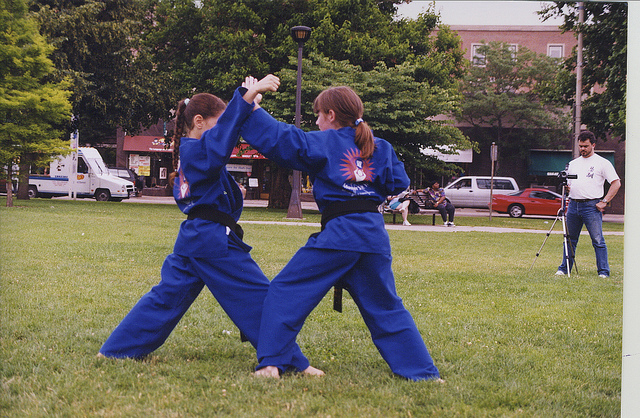
Watching a class is one of the best ways to understand how these disciplines work together. Seeing a student move from a kick to a wrist lock to a controlled fall in under a minute brings the benefits of integrated training to life.
Master S.H. Yu Martial Arts welcomes you to a free class observation. Schedule your free visit below or call us at (708) 383-3456.
Combining Martial Arts FAQs
Is combining martial arts disciplines the same as MMA?
No. MMA is a competition format built around winning matches under a rule set. A traditional combined curriculum blends established martial arts for self-defense, fitness, and character development.
Is it bad to learn two martial arts at the same time?
Not when the arts are taught as one system. Problems usually come from training at two schools with conflicting instruction, such as different stances or footwork. An integrated curriculum sequences the skills so each one supports the next.
What martial art is best to combine with Tae Kwon Do?
Hapkido is one of the most natural pairings. Both are Korean arts, and Hapkido adds the joint locks, escapes, and close-range control that long-range kicking does not cover. Judo then fills the remaining gap with throws and safe falling.
Can I start with one martial art and add others later?
You can, but adding a second school later often means reconciling two systems on your own. Starting in an integrated curriculum lets you build all the skills together from the beginning, so nothing has to be unlearned.
Do I need to be in shape before starting a combined program?
No. Training is how you get in shape. Beginners start at their current fitness level, and instructors adjust intensity so strength, flexibility, and endurance build gradually.
What age can a child begin training multiple martial arts disciplines?
Most children are ready around early elementary-school age, once they can follow group instructions. Look for a beginner class designed for young children, with safe falling taught before any throwing.
Is combined martial arts training effective for real self-defense?
Yes. Real confrontations move between distance, grabbing range, and the ground, and combined training prepares you for each. Good instruction also stresses awareness and avoidance: recognizing danger early so you never need to use what you know.
How long does it take to see progress when training multiple disciplines?
It depends on how often you train, but most students see steady growth training two to four times a week. A structured beginner program gives a clear first milestone, and regular promotion tests mark progress from there.